
July 1, 2025
Blog 7
Obidimma Ezezika
One of the things I’ve learned in my work with health workers, hospitals, and community programs is this: implementation doesn’t fail because people don’t care—it fails because something gets in the way. Sometimes that “something” is obvious, like missing supplies. Other times, it’s subtle, like unclear leadership or weak communication.
That’s why I developed a simple tool called PEEL—a quick, practice-friendly way to identify what’s blocking change before it stalls.
What is PEEL?
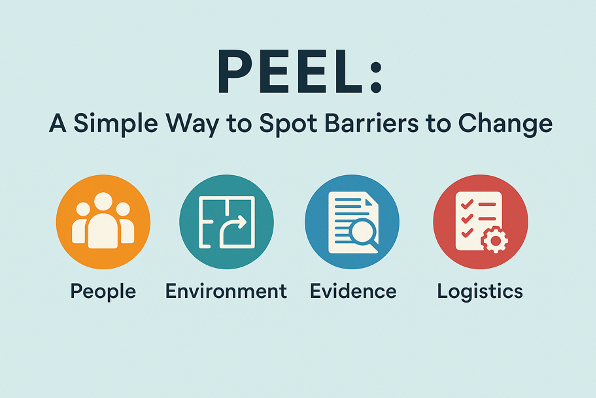
PEEL stands for People, Environment, Evidence, and Logistics. These four categories capture the most common reasons why a promising idea doesn’t translate into action.
- People – Is there a clear leader? Do staff know their roles?
- Environment – Does the workflow or setting actually support the change?
- Evidence – Do people understand why the change matters?
- Logistics – Are the reminders, tools, or supplies really in place?
Instead of staring at a problem and asking, “Why isn’t this working?”, PEEL helps teams quickly scan these categories and land on a practical next step.
Why PEEL Works
Implementation Science gives us excellent frameworks like the Consolidated Framework for Implementation Research (CFIR) and the Plan-Do-Study-Act (PDSA) cycle. But for many frontline staff, those can feel abstract. I designed PEEL to bridge that gap. It distills the science into something simple enough to use during a shift change huddle, but still grounded in evidence about what drives success.
When paired with tools like the 3 A’s—Ask, Adapt, Apply, PEEL not only helps teams see barriers clearly but also decide what small test or adaptation to try next.
A Case Example: The Vanishing Reminders
At one surgical ward, staff struggled to deliver antibiotics on time. Looking through the PEEL lens, the barriers became clear:
- Environment – reminders were in the wrong place.
- Evidence – staff weren’t sure why timing mattered.
- People – no one was accountable.
The solutions were surprisingly simple: move the reminders, assign a nurse lead, and create a short training video. Within 10 days, timely delivery improved by 60%.
How You Can Use PEEL
The next time you face a stubborn implementation challenge, try this mini-checklist:
- What change am I trying to make?
- Which PEEL category does the barrier fall into?
- What’s one thing I could adapt immediately?
Implementation science doesn’t need to stay in textbooks or conference rooms. With tools like PEEL, we can put it directly into the hands of the people making change happen every day.