
July 2026
The 5Cs of Scale: Why Good Technologies Do Not Scale Themselves
Blog 8
Obidimma Ezezika
When I first began studying how health innovations scale, I examined ten cases that eventually informed my book, Scaling Up Health Innovations in Africa: Prospects and Challenges. What fascinated me most was not simply the technologies, but the contexts in which they succeeded, stalled, or became embedded within health systems.
MomConnect was especially striking.
Launched in South Africa in 2014, MomConnect provides pregnant women and mothers with free health information through SMS and WhatsApp, while also enabling questions and feedback through a helpdesk. Almost five million women have registered through more than 95% of the country’s public health facilities.
Its reach cannot be explained by mobile messaging alone. The real innovation was the system capable of delivering, governing, financing, monitoring, and adapting those messages nationally.
This reinforced a lesson that has stayed with me:
Good technologies do not scale themselves. Systems carry them.
Drawing on comparative case research and practical experience, I developed the 5Cs of Scale as a compact diagnostic for assessing whether a system can carry an innovation beyond the pilot stage:
- Custodian: Who would be embarrassed if this stopped working two years from now?
- Compatibility: Does it fit users, workflows, infrastructure, policy, and context?
- Capital: Who keeps paying when the grant stops?
- Capacity: Can the system deliver and support it repeatedly?
- Control: Who notices when performance starts to slip—and who acts?
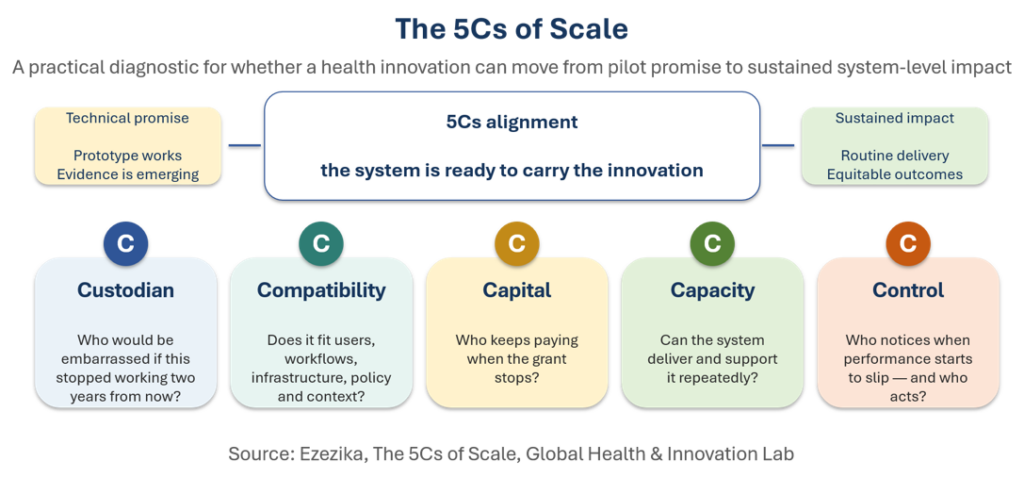
Figure 1. The 5Cs of Scale: five interdependent conditions that shape whether an innovation can move from pilot promise to sustained system-level impact.
For MomConnect, the Custodian was South Africa’s National Department of Health. Compatibility came from integration with public maternal-health services, basic mobile technology, multiple languages, and facility-based registration. Capital combined public funding with donor and technical partnerships. Capacity included frontline workers, provincial structures, technical teams, and helpdesk personnel. Control came through tracking registrations, message delivery, questions, complaints, and facility-level performance.
Rwanda’s HPV vaccination programme illustrates the same framework through a biomedical innovation. Rwanda became the first African country to introduce a national HPV vaccination programme in 2011. More than 1.15 million girls received a first dose between 2011 and 2018, and subsequent research found that the prevalence of four vaccine-targeted HPV types fell by 52% between the two survey periods.
Its Custodian was the Government of Rwanda. Compatibility came from linking health, education, school, and community systems. Capital combined government financing of delivery with vaccine donations and later support from Gavi. Capacity depended on health workers, teachers, community health workers, district officials, and outreach mechanisms. Control included coverage tracking, follow-up, safety monitoring, and local accountability.
The institutional arrangements need not look identical in every setting. A custodian may be a government agency, hospital network, nonprofit organization, insurer, professional association, social enterprise, or private company. Financing may likewise be public, commercial, philanthropic, or blended. Capacity and control may also be distributed across several organizations. What matters is that every essential function is clearly assigned and remains viable beyond the pilot.
The 5Cs shift the scale conversation from “Does the innovation work?” to “Can the system carry it, sustain it, and improve it over time?”
Sources
- South African National Department of Health: MomConnect
- Taking digital health innovation to scale in South Africa: ten lessons from MomConnect
- Designing for scale: the MomConnect health-information architecture
- Achieving scale, sustainability and impact: a donor perspective on MomConnect
- HPV vaccine coverage in Rwanda: a population-level analysis
- HPV vaccine effect against HPV infection in Rwanda
- Achieving high coverage in Rwanda’s national HPV vaccination programme